A year ago, I wrote about hitting our first 100 students.
This week, we crossed 1,000 agents on the Elequate platform.
The number isn't the story. We're still small in the scheme of things, and we're just getting started. But what those 1,000 agents — and the team leaders who brought them — have shown me about where this industry is heading, and where most of it is stuck, is the story.
Why I Started Elequate
I spent years inside Zillow working with hundreds of real estate teams, and I watched the same pattern repeat across nearly all of them. The model they were running used to work. It mostly doesn't anymore.
The model was simple. You bought leads in good zip codes, recruited agents, and handed the leads over. As long as the revenue per lead was bigger than the cost per lead, you scaled by buying more leads and hiring more agents. Spend X, get Y, make sure Y is bigger than X.
That model is breaking now.
On the major high-intent buyer platforms — the ones built around customers who've raised their hand and asked to talk to an agent right now — costs have gone up roughly 10x in the last decade. What used to cost $50 now costs $500 — if you can even get the territory you want, because there's a waiting list of ten teams ahead of you. Margins are thin to the point that even when you win the lead, there's barely anything left after the fees, the split, and the underdelivery.
The platforms aren't the villain here. They are, in fact, one of the most powerful tools a modern team leader has, and I'd argue more strategically valuable today than they've ever been. Let me explain why.
For a team, leads do three things almost nothing else can.
They ramp new talent. Where else in the history of this business has a brand-new agent — in their second week, with no sphere, no past clients, no listings — been able to sit in a real conversation with a real buyer about a real move? The platforms make that possible. New agents get reps fast, and reps are how careers get built.
They flatten the roller coaster. Real estate has always been a business of uncontrollables — inventory, interest rates, seasonality, sentiment. Those things move sphere and friends-and-family business up and down in big swings. The buyer who's clicking the button to speak to an agent right now is telling you that despite those headwinds, they still need to move. When the rest of the database is sitting on the sidelines, the high-intent leads keep filling the gaps. They're a hedge against the parts of the business no one controls.
And they compound into market share. The largest, most successful mega teams in this industry almost all share one thing in common: they took big swings on these platforms ten years ago and figured out the conversion later. Every lead is someone's neighbor, someone's cousin, someone's co-worker — and that lead already knows a competitive agent they didn't call. Taking those leads one by one, month after month, is how you quietly pull a market apart from underneath the competition.
So the programs work. They work spectacularly — for the teams who've figured out how to convert. The teams converting at 10% or higher are printing money inside them and quietly taking ground.
The problem is most teams haven't. So they feel trapped: they don't love the economics, but they can't walk away because they don't have anything to give their agents if they do. The fix isn't to leave the programs. The fix is to get better at the work that turns them profitable.
And while teams have been stuck in that conversion gap, the entire industry has kept building tools to help agents manage their customers. Lead nurture, pipeline software, follow-up tools — all pointed at the agent-customer relationship. Few provide tools that help leaders with their agents.
That's why I started Elequate.
And 1,000 agents later, I think it matters more than I did when I started. Here's what that year has taught me.
What 1,000 Agents Have Taught Me
Three lessons, all stress-tested with the leaders and agents who've come through our platform this year. The first two are about agent development. The third is where I disagree with most of the industry.
Lesson 01
Agent development is the lever. Nobody is pulling it correctly.
Every team leader says agent development is the most important thing they do. Almost none of them are actually doing it.
What they're doing instead is group training. And the dirty secret of every group training is that a third of the room shows up and takes notes, a third shows up and zones out, and a third doesn't show up at all. The session "works" for the agents who were already going to figure it out. Everyone else gets a free pass for another week, and the leader walks away feeling productive without having moved the business an inch.
The other thing they're doing is the one-on-one that opens with "What do you think you need to work on?" — a question agents can't actually answer, because they're three inches from the mirror, wearing six hats, and trying to remember whether they ate lunch. The conversation goes nowhere, the meetings get skipped, the leader fills the gap with more group training, and the loop locks in. The diagnosis is the leader's job. Doing it well isn't glamorous and isn't automatable. It's where almost every team quietly falls apart.
Lesson 02
The bucket has many holes. Each one needs a different patch.
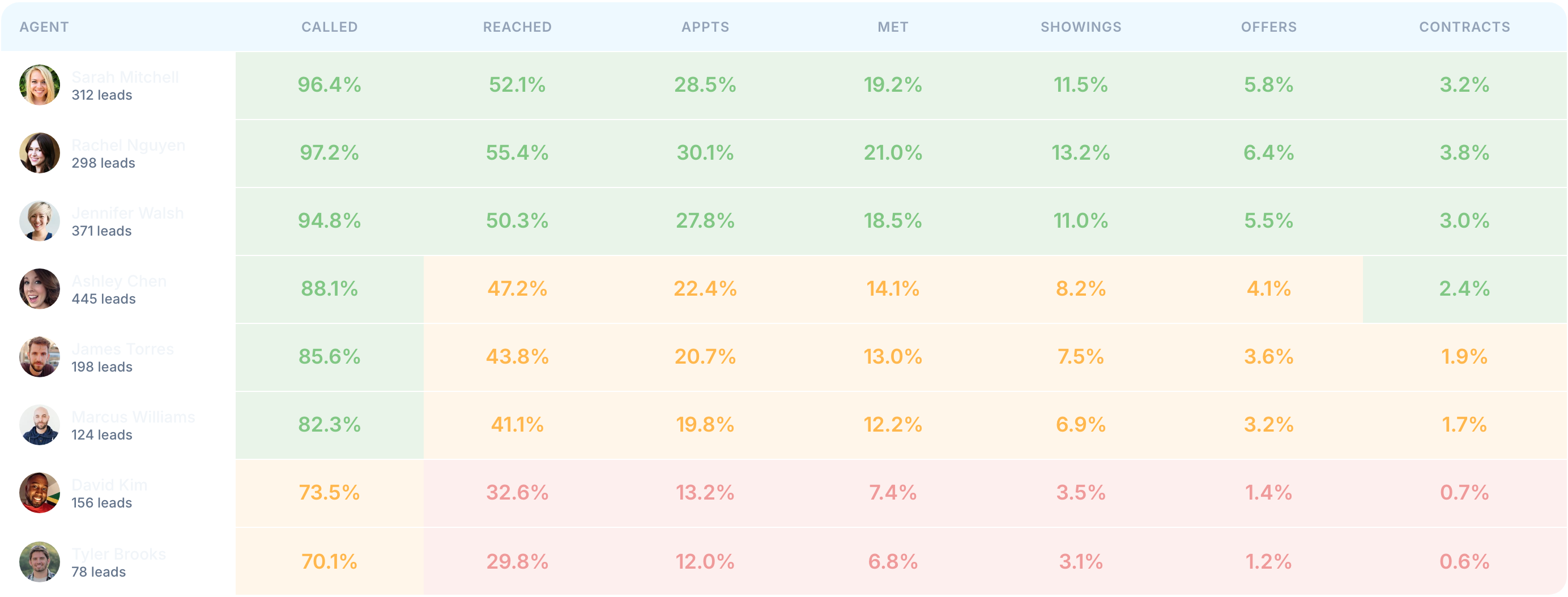
Agents don't have "a sales problem." They have a particular problem at a particular part of the funnel. The agent who isn't making enough calls is a different fix than the agent who makes the calls but can't get anyone to commit. Different stories, different patches.
The trouble is that most leaders are coaching the wrong things — because they don't actually know where the leak is. They have a feel for it: Tom's in a slump. Sarah's killing it. Mike's been quiet. But ask them to point out the break, and more so why it is broken for each agent, and they can't. So coaching defaults to feel-over-real: gut instinct in place of insight, generic advice in place of a real diagnosis. The agent walks out of the meeting with the same problem they walked in with, just better hidden under a pep talk.
Without the data, the conversation can't go anywhere specific. And without specific, it doesn't change behavior.
"feel-over-real: gut instinct in place of insight, generic advice in place of a real diagnosis."
Lesson 03
Agents don't leave teams. They leave leaders.
Ask an agent why they joined a team and they don't say the CRM. They usually say something about the leader.
Ask why they left and the answer rhymes. Our friends at Humaniz showed that the number one reason agents change teams is that they stopped feeling the leader cared about their success.
That's the whole thing. Not comp. Not splits. Not the tech stack. I don't feel like they are invested in me anymore.
A real partnership between an agent and a leader runs both ways. The leader brings time, attention, and a real plan for the agent's growth. The agent brings effort and follow-through. When that exchange is alive, agents stay. When it isn't — when the leader manages from a distance with some version of hit your numbers, do better — agents leave. It's the single biggest predictor of churn we see.
All three lessons taken together paint a picture: leaders need to see their agents more clearly, develop them more individually, and stay closer to them — not further away. This. This is what keeps me up at night, because most of the industry is going in the opposite direction.
The Bet We're Making
Most of the new investment in real estate technology right now is pointed at the same idea: automate sales leadership. Hand the agent one-on-one to the software. Replace the leader's coaching with a dashboard. Move the leader further from the agent in the name of saving time.
I think that's the wrong direction.
Real estate is a relationship business. It has been for fifty years, and the bet I'm making — and building Elequate around — is that it's going to stay one for the next fifty. Even as software gets better at coaching mechanics. Even as AI gets sharper at diagnosing performance gaps. The thing that keeps a great agent on a team isn't a feedback report. It's a leader who knows them, sees them, and is invested in their growth. Take the human leader out of that picture and the math from Lesson 3 catches up with you fast.
I want to be precise about what I'm objecting to, because it's a narrower target than the headlines suggest. There's a lot about a team leader's job that should be automated — calendar coordination, activity tracking, note-taking, pre-call prep, surfacing the right data at the right time. All of that is operational tax around the relationship, and offloading it to software is one of the highest-leverage moves a modern leader can make.
What shouldn't be automated is the relationship itself. The 1:1 conversation. The diagnosis. The accountability. The act of a leader looking an agent in the eye and saying I see what's getting in your way, and here's what we're going to do about it. That's the irreplaceable part. The teams that try to outsource it to software are going to discover, somewhere in year two or three, that they've optimized away the thing their agents were actually paying for.
"Automation has a place in team leadership. The right place is behind the leader — not between them and the agent."
Automation has a place in team leadership. The right place is behind the leader — making them sharper, faster, more prepared. Not between them and the agent. We should be doing everything we can to amplify these relationships, not replacing them.
That's the direction we're building.
What's Next
I'm not going to give away the roadmap. But here's what I'll say: the next phase of Elequate is about giving leaders clearer visibility into what they are doing — not just what their agents are doing. The leaders who engage with their agents the right way get results. The ones who don't, don't. We're going to help leaders see that feedback loop more clearly than they've ever seen it before.
The team leaders and agents who get this right — who use the technology to amplify the human relationships, not replace them — are going to build the environments the best people in this industry want to work in. That's a generational opportunity, and the door isn't open forever.
That's what we're building. That's what 1,000 agents on our platform are telling us matters.
To every team leader, broker, and agent who's been part of this first year: thank you. None of this happens without you.
More soon.